One-Stop Hotel Supply Sourcing: Buying Linens and Room Supplies Together
One-stop hotel supply sourcing explained: consistent specifications, matching colors, simpler communication, and trade-offs. A planning checklist for room setup projects.

When a hotel buys linens or amenities, the supplier on the other side of the table may be a manufacturer, a trading company, or something in between. The labels are often used loosely, and the difference matters. It affects who controls production, who answers for quality, how quickly problems are fixed, and how much room there is to negotiate on specifications.
This guide explains the three common models, what each one usually means for a buyer, and the questions that help you find out which one you are actually dealing with. It does not claim that one model is always better. A well-run trading company can serve a buyer well, and a factory with weak management can fail to deliver.
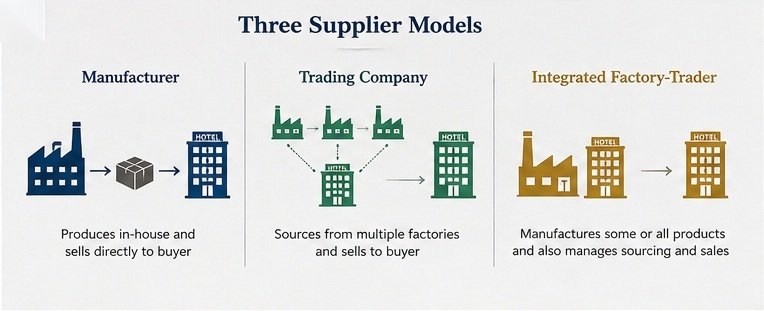
A manufacturer owns or directly operates the production facilities where products are made. It controls spinning, weaving or knitting, cutting, sewing, and finishing, usually within its own plant.
What this usually means for a buyer:
Possible limitations:
A trading company buys products from one or more factories and sells them to buyers. It may have strong sourcing, logistics, and customer service capabilities, but it usually does not control production directly.
What this usually means for a buyer:
Possible limitations:
An integrated factory-trader combines production capability with trading capability. It manufactures some or all of the products it sells and also manages sourcing, export, and customer service. The exact mix varies from company to company.
What this usually means for a buyer:
Possible limitations:
Because the term is used differently by different companies, the most useful step is to ask directly which products the company manufactures and which it sources.
 Why the Difference Matters
When the same company makes and sells a product, it has a direct interest in fixing quality issues. When a trading company sells products from several factories, the buyer should confirm which factory made each item and how quality is checked before shipment.
Embroidery, woven borders, printing, and labels all depend on production processes. A company that controls production can usually explain what is possible, what the setup requirements are, and what affects lead time. A trading company may need to confirm each detail with a factory, which can add time.
Lead time and minimum order quantity (MOQ) depend on the complexity of the product and the process involved. Standard items may be quick to supply, while custom items or complex constructions take longer. There is no single standard for these figures across the industry, so buyers should request them for each specific product and order.
A buyer who specifies a particular GSM, fiber, or fill type needs confidence that the delivered product matches the specification. Ask how specifications are recorded, whether substitutions are allowed, and how changes are approved in writing.
Certifications apply to specific companies, sites, or products. A certificate held by a factory does not automatically cover every item a trading partner sells. Ask for the certificate, check its scope, and verify it with the issuing body where possible.
Whatever the model, these questions help clarify who you are working with:
A clear, specific answer to these questions is usually more informative than a company’s self-description.
The right model depends on what the buyer needs:
Assuming every supplier that says “factory” makes everything it sells. Ask which products are made in-house.
Accepting a certificate without checking its scope. A certificate may cover some products and not others.
Confusing responsiveness with control. A quick reply does not necessarily mean the company controls production.
Requesting customization without confirming capability. Ask what the production process can achieve before approving a design.
Leaving specifications informal. Verbal agreements about GSM, fiber, or color are difficult to enforce. Put them in writing.

Galaxy Hotel Supplies is an integrated factory-trader. We hold ISO 9001 and Oeko-Tex certifications; please ask for the certificates and check their scope against the specific products you plan to order. We supply pillows, duvets, bathrobes, mattress protectors, restaurant linens, and spa linens, and we can provide matching services for other hotel supplies.
We offer custom services including embroidery, woven borders, printing, and labels. Minimum order quantities and lead times depend on the complexity of the product and its production process, so we confirm them for each order rather than applying a single standard.
We do not provide laundry or linen rental services.
Request a quote or sample → Browse our products →
Questions about sourcing from Galaxy? Email us at info@hotelsupplieschina.com
One-stop hotel supply sourcing explained: consistent specifications, matching colors, simpler communication, and trade-offs. A planning checklist for room setup projects.

Hotel spa linens explained: massage table sheets, treatment towels, robes, and pool linens. Fabric, fit, lint, hygiene, and a checklist for approving samples.

In-house vs outsourced hotel laundry compared: volume, turnaround, space, staffing, quality control, and total cost per item. A framework and checklist for deciding.

Hotel mattress protectors and pads explained: waterproof barriers, seam construction, top fabrics, sizing, and laundering. Questions to ask before approving a sample.